Water Conservation Center
2024 WCC Final Report
2025 Demonstrations
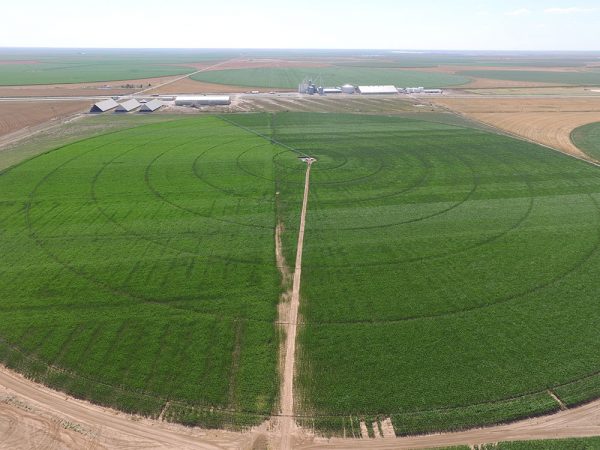
The Water Conservation Center (WCC) at Etter is a wonderful resource to demonstrate practices designed to enhance productivity and sustainability using limited water. The demonstrations are conducted using large fields and real farming equipment, as opposed to doing things at a small plot scale. In this way, the NPGCD hopes to show farmers what can be done using limited water in a realistic and relatable way. The demonstrations will be led by Dr. David Sloane and Dr. Jourdan Bell, and they will conduct a field day in early September to showcase the demonstration plots. The demonstration program will incorporate both center pivots and subsurface drip irrigation (SDI) fields available at the WCC. Below is the layout of demonstrations planned for the 2025 growing season.

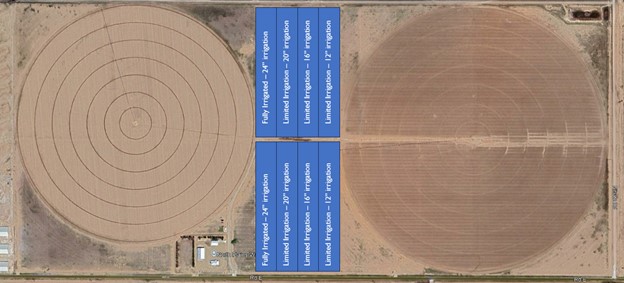
The 2025 demonstration plan at the WCC includes the following:
- Continue to evaluate the role of forage sorghum in a corn / cotton rotation under limited water. This demonstration incorporates split-planting each pivot to also examine how forage sorghum fits into a water sharing situations with both corn and cotton.
- Compare forage sorghum drilled on 7.5” rows and windrowed vs planted on 30” rows and direct harvested to assess the yield, convenience and ROI for each method.
- Compare several new drought tolerant corn hybrids versus commercial lines when grown under limited water and with early and late planting dates. The irrigation treatments will range from a full allocation down to a restricted rate of only 12” for the season. This is roughly equivalent to a range of 4.6 – 2.1 gpm/ac. This should be a great test of growing corn in severely water limited situations.
- Compare and contrast using UpTerra treated water versus untreated water on forage sorghum. Upterra is a system designed to make water behave more like rainfall and the manufacturers claim that it can boost infiltration and soil water holding capacity. In 2024 we saw some positive anecdotal results and this year we plan to take more samples and measurements to better analyze any observed differences.
For more information about the North Plains Water Conservation Center demonstrations contact Baylee Barnes at 806-935-6401 or bbarnes@northplainsgcd.org.


Up to date as of July 8, 2025
History North Plains Water Conservation Center (WCC)?
What is the WCC? In 2014, the North Plains Groundwater Conservation District began focusing the North Plains Research Field at Etter, Texas, as the North Plains Water Conservation Center. The board of directors developed a plan for the operations and staffing of the Center, including articulating the mission as a demonstration field and upgrading the facilities.
The board of directors then selected Stan Spain and Crop Production Services (CPS) out of five proposals to oversee the farming and demonstration at the Center.
CPS management demonstrated a vision for the Center that matches the vision of the board, making the company an excellent corporate partner for the District. CPS spelled out a plan of demonstrating graduated irrigation regimens of 3, 4, and 5 gallons per minute pumping capacity to simulate the conditions faced by most producers in the district. To read more information on the “3-4-5 Program”, click here. Space was also set-aside for demonstration of the District’s award winning “200-12 Project”.
CPS also plans to demonstrate various plant populations as well as multiple crops and crop rotations in their demonstrations at the field including: corn, cotton, sorghum and wheat. These plans are in line with the water conservation focus that the board of directors wants for the Center, but the potential for ongoing coordination with the District in the design and implementation of demonstrations while allowing the District access to all the data is of great value to District stakeholders as well.
In addition to the agriculture conservation demonstrations to be conducted by CPS, the District maintains the Water Conservation Center as a showcase for a variety of conservation practices and innovations. Future demonstrations could include low water use landscaping, rainwater harvesting and gray water reuse.
If you are interested please contact our office at 806-935-6401 or e-mail us at info@northplainsgcd.org